



Category: Media
-
Critical media coverage of “gender-affirming care” was associated with a decline in gender clinic referrals.
An analysis1 of gender clinic referrals in Sweden found an association between “negative” media coverage of “gender-affirming care” – specifically the “Trans Train”2 documentary – and a decrease of 25.4% in referrals to pediatric gender clinics.
- Indremo M, Jodensvi AC, Arinell H, Isaksson J, Papadopoulos FC. Association of Media Coverage on Transgender Health With Referrals to Child and Adolescent Gender Identity Clinics in Sweden. JAMA Netw Open. 2022;5(2):e2146531. doi:10.1001/jamanetworkopen.2021.46531 ↩︎
- https://youtu.be/MVEZ7gELcgY?si=6uc6DZBmGsKlXXQ8 ↩︎
-
More than a third of UK residents in a survey did not know that “transgender women” are male.
More than a third of UK residents in a 2023 survey1 by Murray Blackburn Mackenzie—a Scottish independent policy analysis collective—did not know that “transgender women” are natal males. The findings show significant misunderstanding of the term and emphasize the need for clearer language in policy and media communication.
- Murray Blackburn Mackenzie. (2023, August 7). Clarity matters: How placating lobbyists obscures public understanding of sex and gender. Murray Blackburn Mackenzie. [Link] ↩︎
-
Increased media coverage of “transgender and gender diverse” issues is associated with higher referral rates to pediatric gender clinics.
A 2020 study by Pang et al1. explored the impact of media coverage on the referral rates to two specific pediatric gender clinics: the Gender Identity Development Service in the UK, and the Royal Children’s Hospital Gender Service (RCHGS) in Australia. Analyzing data from over 5,000 referrals collected over an eight-year period, the study found a strong correlation between the amount of “transgender and gender diverse” media coverage and the number of referrals to these clinics. The research highlighted that an uptick in media stories led to increased referrals, with a significant spike observed one week after coverage in the UK and two weeks later in Australia.
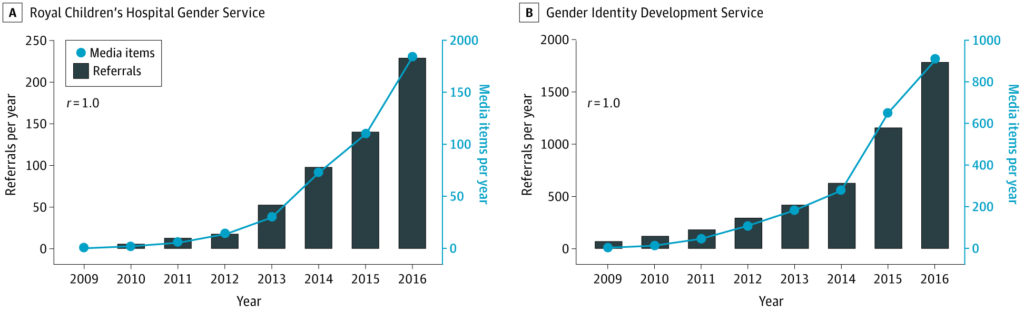
Annual Referrals to the Royal Children’s Hospital Gender Service and Gender Identity Development Service and Transgender- and Gender Diverse–Related Media Stories. - Pang, K. C., de Graaf, N. M., Chew, D., Hoq, M., Keith, D. R., Carmichael, P., & Steensma, T. D. (2020). Association of media coverage of transgender and gender diverse issues with rates of referral of transgender children and adolescents to specialist gender clinics in the UK and Australia. JAMA Network Open, 3(7), e2011161-e2011161. [Link] ↩︎
-
Trans-identified and gender-questioning adolescents engage in significantly more recreational screen time and exhibit higher rates of problematic screen use compared to their peers
Using data from the third year of the U.S. Adolescent Brain Cognitive Development Study, which included 9,859 participants mostly aged 12-13, Nagata et al. (2024)1 found that trans-identified youth report an average of 4.51 more hours of daily screen time, and gender-questioning youth report 3.41 more hours, compared to other youth. This screen time includes activities such as browsing the internet, playing video games, texting, using social media, and watching television and movies. Adjusting for various confounders, the study also indicated higher instances of problematic use of social media, video games, and mobile phones among these groups. Problematic use was defined as being “characterized by inability to control usage and detrimental consequences from excessive use including preoccupation, tolerance, relapse, withdrawal, and conflict.”
- Nagata, J. M., Balasubramanian, P., Iyra, P., Ganson, K. T., Testa, A., He, J., … & Baker, F. C. (2024). Screen use in transgender and gender-questioning adolescents: Findings from the Adolescent Brain Cognitive Development (ABCD) Study. Annals of Epidemiology, 95, 6-11. [Link] ↩︎